00Service index

Eight engineering services,specified in detail

Each service below describes what it covers, the business situations it typically addresses, how we deliver it and the practical value it is intended to produce. Scope is always agreed per engagement; nothing here implies a guaranteed outcome.

  1. S-01Custom software development
  2. S-02Web application development
  3. S-03Cloud solutions
  4. S-04System integration
  5. S-05Technology consulting
  6. S-06Software modernisation
  7. S-07Quality assurance
  8. S-08Maintenance and technical support

S-01

Custom software development

What it is

Applications built for a specific operational process rather than adapted from an off-the-shelf product — internal platforms, back-office tools, scheduling and workflow systems, domain-specific calculation engines.

Typical business needs

Existing tools cover only part of a process, data is re-keyed between systems, or a spreadsheet has become a business-critical dependency that nobody can safely change.

Delivery approach

Discovery workshops, a documented domain model, an incremental build with automated tests, and staged releases into environments that mirror production.

Practical value

A system that matches how the organisation actually works, with the process encoded once and the data held in a single place.
S-02

Web application development

What it is

Browser-based products and portals: customer areas, partner portals, administrative consoles, dashboards and internal tooling, built with current web standards and accessibility in mind.

Typical business needs

Users need access from multiple devices and locations, or a desktop-only tool restricts how a team can work and how quickly it can be updated.

Delivery approach

Interface flows agreed before implementation, component-level design, server-rendered or client-rendered architecture chosen per requirement, and performance and accessibility checks in the pipeline.

Practical value

A responsive interface that can be released frequently and is usable on the devices people already have.

S-03

Cloud solutions

What it is

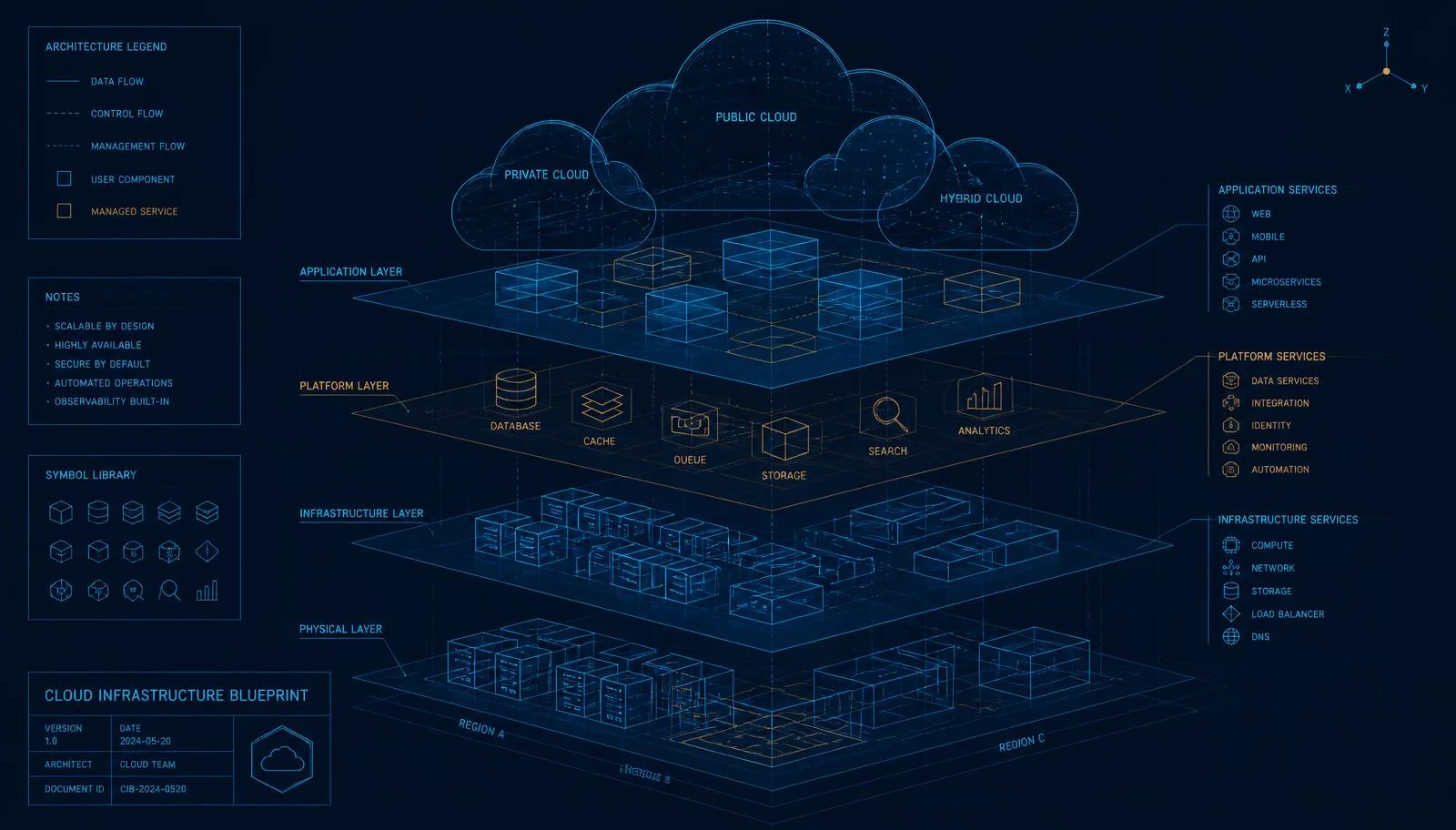
Design and implementation of cloud-hosted environments: compute and storage topology, networking, identity, secrets handling, backup strategy and infrastructure defined as code.

Typical business needs

Capacity planning is hard to predict, on-premise hardware is nearing end of life, or environments differ enough that deployments behave inconsistently.

Delivery approach

Assessment of current workloads, a target topology with cost and operational implications stated, incremental migration, and reproducible provisioning scripts handed to the client.

Practical value

Environments that can be recreated deterministically, scaled with demand, and audited from their configuration rather than from memory.

S-04

System integration

What it is

Connecting applications, data stores and third-party services so information moves reliably: APIs, message queues, scheduled transfers, event streams and reconciliation logic.

Typical business needs

Departments hold separate versions of the same record, manual exports are used to bridge systems, or a new service must exchange data with legacy software.

Delivery approach

Interface contracts documented and versioned, idempotent handlers, retry and dead-letter handling, and monitoring on every integration point.

Practical value

Fewer manual transfers, traceable data movement, and clear ownership of each record across systems.

S-05

Technology consulting

What it is

Independent technical review and planning: architecture assessments, build-versus-buy analysis, technology selection, delivery process review and technical due diligence support.

Typical business needs

A decision has significant long-term cost implications and the team wants a second, non-vendor perspective before committing.

Delivery approach

Structured interviews, code and infrastructure review, a written report with findings, options and trade-offs, and a working session to agree next steps.

Practical value

Decisions taken with the constraints written down and the reasoning available to whoever inherits them.

S-06

Software modernisation

What it is

Progressive renewal of systems that still carry business value but are expensive to change: dependency upgrades, restructuring, data migration and staged replacement of components.

Typical business needs

Releases are slow and risky, the platform is unsupported, or the knowledge required to change the system rests with very few people.

Delivery approach

Characterisation tests around current behaviour, incremental extraction of components behind stable interfaces, and parallel running where the data model allows.

Practical value

A reduced-risk path away from legacy constraints without an all-at-once rewrite of a working system.

S-07

Quality assurance

What it is

Test strategy and implementation: unit, integration and end-to-end suites, test data management, regression coverage, performance testing and accessibility verification.

Typical business needs

Regressions reach production, releases require lengthy manual verification, or nobody is confident about which areas are actually covered.

Delivery approach

A test pyramid appropriate to the system, automated execution in continuous integration, coverage reporting on meaningful paths, and defect triage that feeds back into the process.

Practical value

Faster review cycles and a documented, repeatable basis for deciding whether a release is ready.

S-08

Maintenance and technical support

What it is

Ongoing care for systems in production: dependency and security updates, monitoring and alert tuning, incident response, small enhancements and capacity review.

Typical business needs

A delivered system needs continuity of care, or an internal team needs additional depth outside its core hours and skill set.

Delivery approach

Agreed response expectations, a shared ticket queue, documented runbooks, post-incident notes, and a regular review of recurring issues.

Practical value

Known ownership when something breaks, and a system that keeps receiving the updates it needs to stay supportable.

Layered blueprint schematic of cloud infrastructure showing application, platform, infrastructure and physical layers
Fig. D — Layered view used in cloud engagements

09How engagements are shaped

Fixed scope, staffed team, or advisory

Services are combined into an engagement that suits the situation. A bounded piece of work with a clear specification can run as a fixed-scope project. Continuous product development is usually better served by a dedicated team working within the client's planning cycle. Where an internal team already exists, we contribute as reviewers, architects or specialists on defined topics.

Whichever form applies, the working agreement records scope, communication rhythm, environments, access, review points and the definition of done before implementation starts.

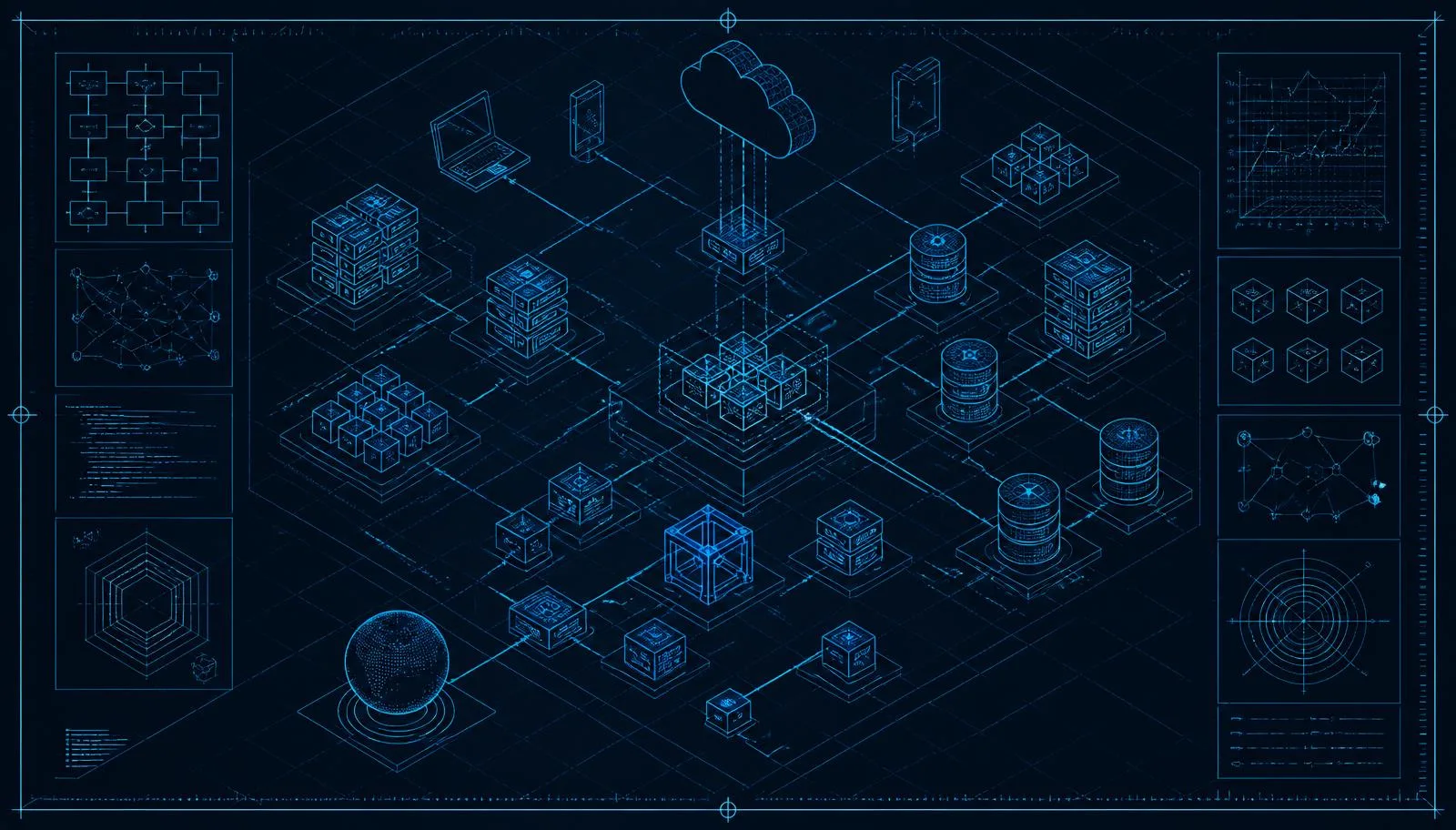
Isometric blueprint of a distributed application architecture with services, databases and client devices
Fig. E — Reference architecture drawing maintained through delivery